A Norman homeowner’s guide
Ice is Oklahoma’s quiet tree killer.
Tornadoes get the sirens. Glaze ice does more damage to more trees — slowly, silently, a quarter inch at a time. Here is how it works and what to do about it.
October 2020, the benchmark
Late October 2020, freezing rain settled over the Oklahoma City metro for days. The trees were still in full leaf — the first hard freeze had not come yet — and every leaf held its own coat of ice. Canopies that had stood through decades of wind failed in a single night, not from any gust but from pure, patient weight. Across Norman and the whole metro, mature silver maples lost half their crowns, Bradford pears folded like closed umbrellas, and the sound most people remember is cracking wood in the dark, over and over.
The cleanup ran for years, and the pruning decisions made in the months after that storm are still deciding which trees stand today. That is the real lesson of 2020: what happens to your trees in an ice storm is mostly decided before the ice arrives.
Why glaze breaks trees
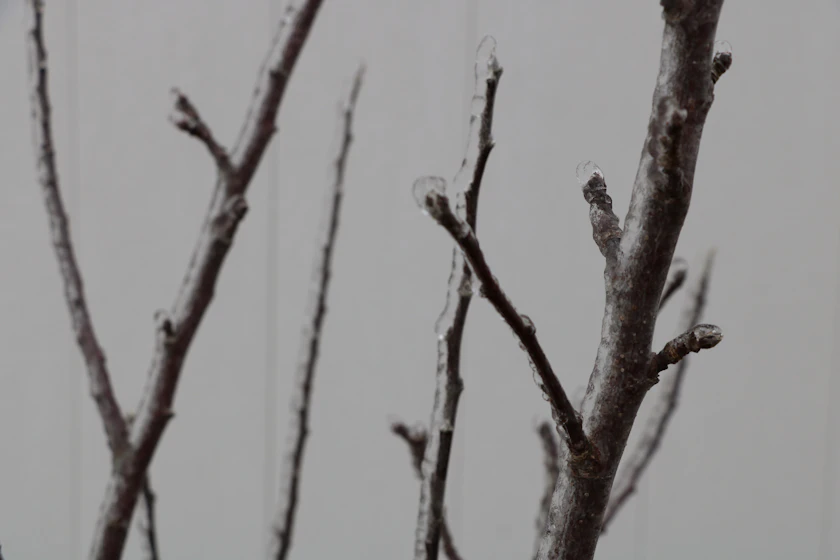
Freezing rain is rain that stays liquid until it touches a cold surface, then freezes on contact. It coats every twig, every branch, every leaf in a growing shell of clear ice. The load lands everywhere at once and never lets up — unlike wind, which comes in gusts a tree can flex through. Wood that would shrug off a thunderstorm fails under a static load it cannot shed.
Two things make a given storm worse. Leaves: an early-season glaze on a canopy still in leaf, like October 2020, multiplies the surface area holding ice. And wind after the ice: even a modest breeze moving a loaded canopy snaps wood that was barely holding. Ice season here runs from late October into the heart of winter, which is why our trimming calendar points at it all year.
The trees that fail first
Ice storms are ruthless about species and structure.
- Bradford and other Callery pears are the first to go. Their tight, upright forks trap bark between the limbs — a seam instead of a weld — and whole scaffold limbs peel off under load.
- Silver maple grows fast and pays for it with brittle, weakly joined wood. Big old silvers over houses are the classic Norman ice casualty.
- Siberian elm sheds limbs in fair weather; under ice it comes apart in earnest.
- Hackberry is everywhere in older Norman neighborhoods, and its wood is weaker than its size suggests.
- Post oak and bur oak hold up best — slow-grown, strong wood, wide forks. Their weakness is recovery: a post oak that does break heals slowly and resents heavy corrective pruning afterward.
None of this means a maple must come down. It means species tells you where the risk sits, and structure tells you what to do about it.
Topped trees break worst
Somewhere in Norman right now, a crew with a ladder is offering to “top” a tree so it will be “safer in storms.” The opposite is true. Topping shears the crown off at an arbitrary height, and the tree answers with a rush of fast, upright shoots clustered at each cut — attached to the outer wood only, over stubs that are meanwhile rotting. Within a few seasons the tree carries a bigger, denser sail than before, hung on the weakest attachments wood can make. Ice finds them first. The International Society of Arboriculture’s plain-English explanation at treesaregood.org is worth ten minutes of any tree owner’s time.
If a topped tree came with your house, it can often be rebuilt — slowly, by selecting the strongest sprouts and training them back into a real structure over several dormant seasons. That is patient work, and it is what restoration trimming is for.
Tornado damage is a different animal
Norman gets both flavors. The April 2024 EF1 that tracked through town and the November 2024 metro tornadoes tore trees rather than loading them: twisted trunks, whole root plates lifted, limbs speared through canopies, wounds packed with debris. Torn wood is harder to read than ice-broken wood — cracks run hidden down the trunk, and a tree that looks merely leaning can be holding on by a hinge. After wind events we look harder at the trunk and roots than at the crown, and the honest answer is removal more often than anyone likes. A cracked trunk does not heal into a safe one.
Call now, or let it ride
During and right after an ice storm, triage is simple. Call immediately about: anything on a structure or vehicle; broken limbs hanging over places people walk, park, or play; a leaning tree with lifted roots; anything touching a line — and for lines, call the utility before you call us. Stay away from sagging service drops entirely.
Let it ride: interior breakage high in the crown, scattered small wood on the lawn, a shed limb lying over open ground. Booking that cleanup for the quiet season costs less and lets crews spend the emergency window on people with trees in their living rooms. One more plea from people who see the aftermath: loaded, bent limbs release like springs when cut. The week after an ice storm is the most dangerous week of the year to be an amateur chainsaw owner. Let it ride, or let us.
The recovery takes years
An ice-wrecked tree is not repaired in one visit. The first pass takes the hazards: hangers, stubs, torn wood cut back to clean tissue. Then the tree gets a season or two to respond, and restoration pruning follows the response — choosing new leaders, spacing the regrowth, taking the weak sprouts before they get big enough to matter. Rushing that sequence, or letting someone strip the whole crown “to be safe,” finishes the storm’s work for it. OSU Extension publishes good storm-recovery guidance for Oklahoma homeowners, including when a damaged tree is worth saving and when it is not.
Get ahead of the next one
The cheap moves, in order. Prune young trees for structure — one strong leader, wide-angled limbs, no bark-trapped forks; ten minutes with loppers on a young tree buys more ice resistance than any amount of surgery on an old one. Reduce the long, over-extended limbs hanging over your roof while the weather is calm. Refuse topping, always. When you replant after a loss, plant for the next fifty years of Oklahoma weather — oaks and other strong-wooded natives over the fast and brittle. And keep one eye on the NWS Norman forecast office from late October on: freezing-rain forecasts come with days of warning, which is exactly enough time to get a hanging limb off the roof but not enough to trim a whole tree properly.
The best time for all of it is December through February, when the trees are dormant and the calendar is quiet. Ours included.
Get the trees ready before the glaze.
A calm-season look at your trees costs nothing and beats any emergency.